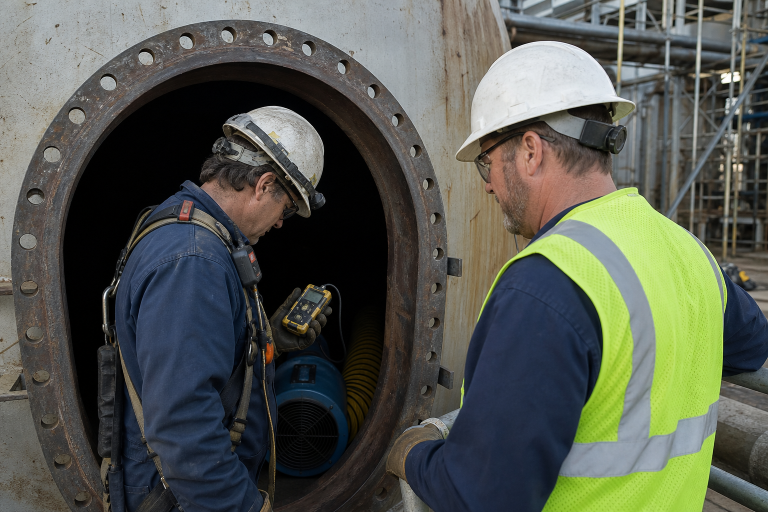
Key Takeaways
- Confined spaces can contain life-threatening atmospheric and physical hazards, even when they appear ordinary.
- Every entry should begin with hazard identification, isolation, air testing, ventilation, assigned roles, and a rescue plan.
- Conditions can change quickly during cleaning, welding, pumping, chemical use, or nearby process work.
- Permit-required spaces need written procedures, trained workers, reliable communication, and close supervision.
- Workers should leave immediately when alarms sound, ventilation fails, or unsafe conditions develop.
A tank, maintenance hole, vault, crawl space, pit, silo, or sewer can become a deadly work area in minutes. A practical confined space definition starts with more than the size of an opening. It also considers whether workers can enter to perform a task, whether access is restricted, and whether the area was designed for continuous occupancy.
Confined space safety matters because hazards are often difficult to see, smell, or predict. A worker may enter a tank that seemed safe during an inspection, only to encounter toxic vapors left behind after cleaning, oxygen depletion caused by rusting metal, or a sudden release from a connected pipe. Limited exits can also escape and rescue much harder.
What Makes a Space Hazardous?
A confined space is not automatically a permit-required space, but it always deserves careful evaluation. Restricted entry or exit, limited room to move, poor natural airflow, and difficult communication are warning signs. Hazards may include unsafe air, engulfment by grain or sludge, moving equipment, heat, electrical energy, falling objects, pressure, or unstable surfaces.
For general industry workplaces, OSHA confined space requirements define a permit-required confined space as one that has, or could have, a hazardous atmosphere, engulfment potential, a trapping configuration, or another recognized serious safety or health hazard. Employers should evaluate spaces before work begins, not after a problem appears.
Permit-Required and Non-Permit Spaces
Non-Permit Spaces
A non-permit confined space does not contain, and is not expected to contain, hazards capable of causing death or serious physical harm. Even so, workers should inspect it before entry, confirm that site conditions have not changed, and follow company procedures. A non-permit classification does not guarantee that the space will remain safe.
Permit-Required Spaces
Permit-required spaces need stronger controls. A written permit should identify the space, list expected hazards, document acceptable entry conditions, record air-test results, identify entrants and attendants, and explain emergency procedures. Classification can change when chemicals, stored materials, hot work, new equipment, or connected systems introduce added risk.
Common Confined Space Hazards
Atmospheric hazards are among the most dangerous. Oxygen-deficient or oxygen-enriched air, flammable vapors, combustible dust, carbon monoxide, hydrogen sulfide, and solvent vapors can quickly incapacitate a worker. Air may vary from the top to the bottom of a space, so testing should account for different gas behavior and potential layering.
Physical hazards are equally important. Workers can be buried by loose material, caught in augers or mixers, burned by hot surfaces, injured by unplanned equipment startup, or trapped by inward-sloping walls. Water, wastewater, steam, gas, and chemicals can also enter through pipes, valves, drains, or process connections unless those systems are properly isolated.
A Five-Step Pre-Entry Safety Plan
- Identify the space and the work. Locate entry points, connected equipment, nearby operations, and foreseeable hazards.
- Decide whether an entry is necessary. Use cameras, remote cleaning tools, external inspection methods, or other alternatives whenever feasible.
- Control energy and materials. Lock out machinery, isolate lines, drain contents, block movement, and prevent unexpected releases.
- Test and ventilate the atmosphere. Check oxygen, flammability, and toxic contaminants before entry and as conditions require during the job.
- Verify rescue readiness. Confirm trained responders, communication methods, retrieval equipment, access routes, and emergency contacts.
Atmospheric Testing and Ventilation
Use a calibrated direct-reading monitor and test the atmosphere before entry. Test high, middle, and low areas when the space’s shape and hazards allow layered air. Workers should understand monitor readings and alarms, but they should never treat a monitor as a substitute for hazard control.
Forced-air ventilation can reduce certain atmospheric hazards by drawing clean air from a safe location and delivering it to the work area. Ducting should not simply blow contaminants toward entrants or spread vapors into nearby work zones. If ventilation stops, monitor readings rise, communication fails, or a worker feels dizzy or unwell, everyone should leave, and the entry should be reassessed.
Guidance on testing, monitoring, and ventilating the atmosphere reinforces an essential point: atmospheric conditions may change after entry due to the task, the materials used, or nearby operations. Continuous monitoring may be necessary during welding, coating, cleaning, pumping, or other work that creates or releases contaminants.
Worker Roles and Communication
Authorized Entrant
The entrant understands the hazards, uses required protective equipment, maintains contact with the attendant, and exits immediately when ordered or when unsafe conditions arise.
Attendant
The attendant remains outside the space, tracks entrants, monitors conditions, prevents unauthorized entry, and summons rescue support when needed. An attendant should not make an unplanned entry to rescue a coworker.
Entry Supervisor
The entry supervisor confirms that the permit, isolation measures, testing, equipment, personnel, and rescue arrangements are in place. This person must stop work when permit conditions are not met and cancel the permit upon job completion.
Rescue Planning: Prepare Before the Emergency
Confined-space emergencies often become worse when untrained coworkers enter to help. Where appropriate, use non-entry rescue equipment such as a full-body harness, a retrieval line, a tripod, and a mechanical winch. Some spaces require a trained rescue team with specialized respiratory protection and extraction equipment.
A workable rescue plan includes site access details, emergency contact numbers, location of the space, known hazards, patient extraction methods, and clear directions for responders. Practice drills are essential. A plan that exists only on paper may fail when workers are under pressure.
Training, Equipment, and Program Management
Training should cover space identification, permit procedures, monitor use, ventilation, lockout and isolation, hazard recognition, communication, retrieval systems, and evacuation. Protective equipment must align with the hazard assessment. It may include gloves, eye protection, hard hats, hearing protection, fall protection, gas monitors, radios, lighting rated for hazardous locations, and respiratory protection, where required.
Managers can strengthen their program by maintaining a confined-space inventory, labeling entrances, restricting unauthorized access, documenting permits and training, inspecting equipment on a schedule, and reviewing near misses. Contractors, staffing agencies, and host employers should coordinate responsibilities before work begins.
Final Checklist Before Entry
- Has the space been evaluated and correctly classified?
- Is entry truly necessary?
- Are pipes, equipment, energy sources, and materials isolated?
- Has the atmosphere been tested with working equipment?
- Is ventilation operating effectively?
- Are the entrant, attendant, and supervisor assigned?
- Are communication and retrieval systems ready?
- Does every worker know when to stop work and exit?
See also: Why Legal Representation Matters in Family Law Conflicts
Conclusion
Confined space safety depends on preparation, not luck. A strong program identifies hazards before entry, controls changing conditions, gives every worker a clear role, and plans rescue before anyone crosses the opening. Careful testing, reliable communication, effective isolation, and trained decision-making can prevent a routine task from becoming a fatal emergency.