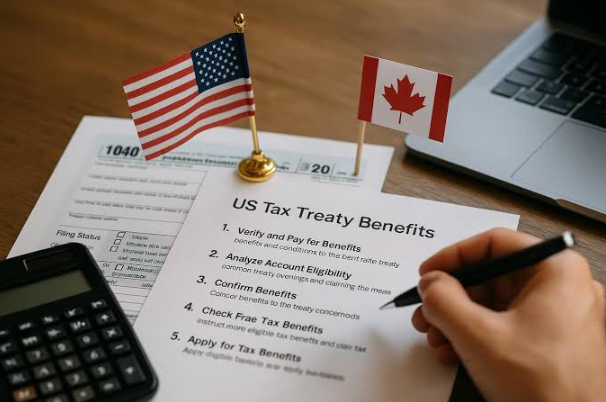
Filing personal tax in USA obligations while living in Canada is one of the more misunderstood corners of individual tax law, largely because so few people realize the obligation exists until years after it should have started. U.S. citizenship or green card status carries a filing requirement that follows you regardless of where you live, how long you’ve been away, or how little connection you feel to the country anymore. At Webtaxonline, we work with a steady stream of Toronto residents who fall into this category, often people who were born in the U.S., moved to Canada as children, and had no idea a filing obligation was quietly accumulating in the background the entire time.
This article explains who actually needs to file a U.S. personal return while living in Canada, what forms typically come into play, how the foreign earned income exclusion and foreign tax credit work together, and what to do if you’ve fallen behind. For situations that combine personal and business filing needs, our cross border tax accounting team handles both sides together rather than treating them separately.
Who Actually Needs to File
U.S. citizens and green card holders are required to file a personal tax USA return every year, regardless of where they live or how much of their income comes from outside the country. This includes people born in the U.S. who moved away as infants and have never held a U.S. passport as adults, as long as citizenship was never formally renounced. It also includes green card holders living in Canada who never went through the process of formally surrendering that status, even if they haven’t set foot in the U.S. in years. A lot of people assume that living entirely outside the country for decades quietly ends the obligation. It doesn’t work that way, and the filing requirement continues until citizenship or residency status is formally and correctly terminated.
See also: Practical Financial Wellness Tips for Everyday Life
The Forms That Typically Come Into Play
Most individuals in this situation file Form 1040, the standard U.S. individual return, reporting worldwide income including Canadian employment income, investment earnings, and any rental income. Beyond the return itself, anyone with foreign financial accounts exceeding certain thresholds, including everyday Canadian bank and investment accounts, needs to file an FBAR disclosing those accounts to the U.S. Treasury. A related but separate requirement under FATCA may also apply depending on account balances and the types of assets involved. These aren’t optional add-ons triggered only in unusual circumstances; for many Toronto residents with U.S. filing obligations, they apply every single year as a matter of course.
How Double Taxation Gets Avoided
Two tools generally prevent someone from paying full tax twice on the same income. The foreign earned income exclusion allows a certain amount of foreign employment or self-employment income to be excluded from U.S. taxation entirely, provided specific residency tests are met. The foreign tax credit, used more often by higher earners or those with investment income, credits U.S. tax owed by the amount already paid to Canada on the same income. Choosing between these approaches, or combining them correctly, depends heavily on income type and level, and picking the wrong strategy for a given year can mean paying more than necessary or losing access to credits that would have been more valuable in future years.
Catching Up When You’ve Fallen Behind
A significant number of people we work with haven’t filed in years, sometimes decades, simply because they never knew the requirement existed. The IRS offers a streamlined filing procedure specifically designed for this situation, allowing eligible individuals to file the last three years of returns and six years of FBARs without the penalties that would normally apply to years of non-compliance. This program only works properly when the back-filing is accurate and the eligibility criteria are genuinely met, since a mistake made while trying to fix years of missed filings creates a much harder problem to unwind afterward.
A Situation We See Often
A woman born in Detroit who moved to Toronto with her family at age four had lived her entire adult life in Canada, married a Canadian citizen, and built a career here without ever realizing her U.S. birth created an ongoing filing obligation. She only discovered the issue when a Canadian bank asked about her U.S. citizenship status as part of standard FATCA-related account screening. Once we reviewed her situation, we used the streamlined filing procedure to bring her current on the required returns and FBARs without triggering the penalties that would have applied to someone filing outside that program. Her case is far from unusual; we see some version of it regularly among Toronto residents with U.S. birth connections.
Coordinating Both Countries at Once
Filing a U.S. personal return in isolation, without considering how it interacts with the Canadian return for the same year, tends to produce a worse outcome than treating both as connected pieces of one overall tax position. Our cross border tax advisor team reviews both returns together specifically to make sure credits, exclusions, and reported income line up consistently across both filings rather than being prepared independently by people who never compare notes.
Conclusion
Personal tax USA obligations don’t disappear just because someone has lived in Canada for years or decades without giving it much thought. Citizenship and green card status carry filing requirements that continue quietly in the background, and catching up correctly, ideally through the right program before the IRS identifies the gap independently, makes an enormous difference in how smoothly that correction goes. Anyone with U.S. citizenship or residency ties living in Toronto is better served getting ahead of this than waiting for a bank form or a border agent to bring it to their attention first.