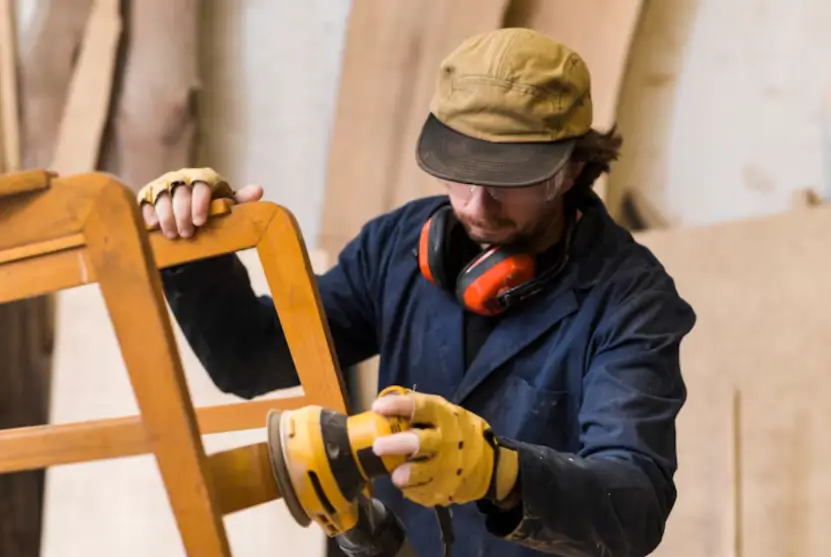
People who usually begin sanding choose a sander that they think will give them a smooth finish without any problems, only to produce swirl marks, uneven surfaces, or even cause damage to the wood. This is usually because the person working with the power tools has rushed the job, or they did not realize the importance of control. An electric sander is not very rough by itself; however, it can be extremely rough when it is not used with care.
The positive side is that clean and safe sanding is not difficult as long as you have the basic guidelines understood. In most cases, the problem is with the technique and not the machine. When you understand how pressure, grit choice, dust control, and motion work together, results improve quickly without needing advanced skill.
This guide outlines practical tips for safely working with an electric sander on wood.
1. Choosing the Right Electric Sander Model
Using an electric sander for wood starts with matching the tool to the surface instead of forcing one machine to do everything. The balance, orbit, and pad size of electric sanders are all important contributors to control. Detail work is done on smaller pads, while flat panel movement is stabilized on larger pads.
Most beginner issues start with the wrong tool choice. A compact sander provides more control when working with edges, but it is sometimes sluggish on wide boards. Bigger models move the material evenly, but also require more stability to use. The idea isn’t to gain power; instead, it is to be consistent on the surface.
Most modern finishing systems, such as cabinetry and furniture finishing systems, do not give any emphasis to aggressive sanding; rather, they concentrate on controlled sanding. This translates to reduced vibration, smoother hardwood and softwood movement, and greater predictability of movement. These systems are often implemented by woodworkers to avoid surface mistakes that are more challenging to correct later.
In addition, some knowledge of product structure is very useful. For example, surfacing systems found in professional sanding collections like electric sanders for wood are designed around finish quality rather than bulk removal. That distinction will mean more than most beginners realize.
2. Choosing the Right Sandpaper and Interface Pads
The choice of sandpaper makes all the difference. The same electric sander can use either a sanding grit for polishing wood or a sanding grit for surface ruining. Coarse grits catch material quickly but will leave coarse scratches. Fine grits polish the surface; however, these will take time and require regular scraping.
Abrasive behavior is also affected by the wood type. Softwoods such as pine take up sand rapidly and may become oversanded if too much pressure is applied. In contrast, oak is a hardwood that requires a longer time but offers signs of steady progress through the growth stages. Skipping steps generally results in uneven finishes, which are only evident after staining.
Foam interface pads provide yet another level of control. They disperse pressure more evenly, particularly on curved or intricate surfaces. The pad cushions the movement and minimizes the risk of gouges rather than cutting hard lines. This can be particularly helpful when completing projects where surface uniformity is more important than speed.
Studies on surface finishes and the interaction of particles indicate that dust emission and finish quality are related to the consistency of abrasives. Controlled abrasion also minimizes the occurrence of microfractures in wood fibers and promotes surface uniformity.
3. Dust Control Health Protection
Sanding a wood surface generates small dust particles that can be difficult to see. The dust problem is not only one of cleanliness, but it is also one of breathing comfort and risk of long-term exposure. Even small sanding tasks can produce floating dust particles that remain in the air for a longer time than expected.
Health studies state that long-term exposure to wood dust has consistently been found to be a cause of irritation to the respiratory tract. Furthermore, measurable changes in lung function can occur with repeated sanding activity in the environment.
By correctly attaching the sander to a dust collection system, airborne particles can be substantially reduced. In fact, dust collection is much more effective at the source than after it has already spread. Even simple vacuum-assisted systems achieve better visibility and limit surface buildup on the sanding area, thereby ensuring more uniform contact.
A simple respirator and eye protection reduce irritation and allow controlled work sessions of longer duration. In addition, good airflow around the work area improves accuracy because dust interference can hide surface defects during sanding.
4. Sanding Technique Surface Control
Proper sanding technique determines whether the surface becomes smooth or uneven. Pressure is the most common mistake. Many beginners press harder, thinking it speeds up the process, but it usually creates dips and inconsistent texture.
A steady, overlapping motion produces the best results. The sander should glide without forcing direction changes. Letting the pad rotate naturally keeps abrasion even across the grain. Sudden stops or lingering in one spot often create visible marks that require additional correction.
Surface control improves when movement follows the wood grain instead of crossing it aggressively. While cross-grain sanding is sometimes necessary in early stages, final passes should align with the grain to refine texture. This reduces visible scratches after finishing or staining.
Vibration control also plays a role. Lower vibration tools reduce fatigue and improve precision during longer sanding sessions. Less hand strain means steadier motion, which directly improves surface quality. Small adjustments in grip position can also reduce uneven pressure distribution.
See also: How Smart CCTV Technology Enhances Security Measures
5. Safety Habits Workshop Discipline
Safe sanding is less about caution and more about routine. Consistency in setup and handling prevents most mistakes before they happen. A stable work surface is the starting point. Loose boards or unstable benches introduce movement that affects sanding accuracy.
Tool inspection should become automatic. Checking pad condition, dust ports, and abrasive alignment takes seconds but prevents uneven sanding. Worn pads often create unexpected marks that are difficult to trace back to the source.
Work rhythm matters as well. Short controlled passes are more effective than long continuous sanding sessions. This reduces heat buildup on both wood and abrasive surfaces. Excess heat can burn wood fibers, especially on softer materials, leaving permanent discoloration.
Ergonomics also influences safety. Hand position should remain relaxed, not locked. Over-gripping increases fatigue and reduces fine control. Small posture adjustments help maintain accuracy across larger surfaces without strain.
Conclusion
Electric sanding is about control, sequence, and understanding how wood responds under friction. When tool choice, abrasive selection, dust control, and technique work together, results become consistent and predictable. Small adjustments in handling often make a bigger difference than switching tools.
Beginners improve fastest when they focus on steady movement rather than speed. Light passes, proper grit progression, and dust safety from the start create cleaner finishes and reduce the need for corrections later. Consistency in each pass builds surface quality that is difficult to achieve through rushed work.