A founder’s honest, numbers-first account of what worked, what broke, and what I’d do differently.
On January 8th, I sent three goodbye messages. One to a virtual assistant who’d been handling my inbox for two years. One to a content researcher who built weekly briefings for my newsletter. One to a customer support contractor who covered nights and weekends for my SaaS side project.
Combined, they cost me $4,720 a month. Combined, they did good work. I was not unhappy with any of them.
I let them all go anyway, because I wanted to know if AI agents could actually do what every Twitter thread claimed they could. Ninety days later, I have the receipts. Some of them are not what I expected.
The setup, with real numbers
Before I get into what happened, here’s what I was actually paying for.
My VA handled around 180 emails a week. Triage, drafting replies, scheduling, following up on invoices. She charged $1,800 a month and was worth every dollar. My research contractor pulled together a weekly briefing of about 40 industry links with summaries for my newsletter. That ran $1,600 a month. My night and weekend support contractor handled roughly 60 tickets per week on a small SaaS product I run on the side. That was $1,320 a month.
Total monthly outlay: $4,720. Total monthly hours of human labor: about 160.
I decided to replace all three with autonomous agents built on OpenClaw, the open-source agent framework that’s been quietly eating the AI tools conversation for the past year. I budgeted $400 a month for everything, including model API costs and infrastructure.
Day 1 to Day 14: the painful part
Here’s the part nobody mentions in those breathless “I built an AI empire” threads. The first two weeks were brutal.
I started by trying to self-host OpenClaw on a $12 DigitalOcean droplet because I’m cheap and stubborn. By day three, I had spent eleven hours fighting Docker permissions, debugging YAML configuration files that looked correct but weren’t, and watching my agent crash every time it tried to access more than 4GB of memory. The infrastructure work was eating the time I was supposedly saving.
By day five, I gave up on self-hosting and moved to a managed service. I spent an evening comparing options, including running my own VPS with a babysitter script, paying for a generic PaaS, and using a dedicated AI agent platform built specifically for OpenClaw deployment. The dedicated managed route won because I didn’t want to learn new tools every time something broke at 2 a.m.
By day ten, my first agent, the email triage replacement, was actually running. By day fourteen, it had answered 47 emails without me touching anything. Three of them were wrong in ways that made me wince. The other 44 were fine.
Day 15 to Day 45: things start working
This is where it gets interesting.
Once the email agent stabilized, I built the research agent next. This one was easier because it didn’t need to take real action, just read, summarize, and post a digest to my Slack every Friday morning. It took about four hours to configure. The first weekly briefing was 70 percent as good as my contractor’s. The fourth weekly briefing was, honestly, better. Not because the agent was smarter than her, but because it could read 200 sources instead of 40 in the same amount of time.
The customer support agent was the hardest. I scoped it carefully, gave it access to my docs and the support ticket database, and told it to draft responses for every incoming ticket but never send anything without a human checking first. After two weeks, I changed the rule. It could send responses on its own for tickets it was more than 90 percent confident about. That covered roughly 60 percent of inbound volume.
By day 45, I was running three agents, and my actual total cost was $312 a month. Eighty-seven of that was platform fees. The rest was model API spend. I was nervous about token costs spiraling, but a friend pointed me to a useful breakdown of what running OpenClaw agents really costs that helped me model my burn rate accurately. It turned out the math was fine. I was overthinking it.
Day 46 to Day 90: the part I didn’t expect
The numbers got better. The feelings got weirder.
By day 60, my email agent was handling 92 percent of my inbox without intervention. My research agent had become genuinely indispensable. My support agent was clearing 71 percent of tickets autonomously and escalating the rest with thoughtful summaries that made the eventual human response faster.
Total time I spent managing all three agents per week: about 90 minutes. Total time I used to spend coordinating with three human freelancers per week: about 6 hours.
But here’s the thing nobody warned me about. I missed the humans. Not in a sentimental way. In a practical way.
My VA used to flag things that weren’t really email problems. “Hey, three different customers asked the same question this week, you might want a help doc for that.” My research contractor used to send me random ideas she’d had in the shower. My support contractor knew when a complaint was actually a sales opportunity in disguise.
The agents do not do this. They are extremely good at the task you gave them and completely blind to the task you didn’t. That blindness is a real cost, and I underestimated it.
The financial reality
Let me give you the actual 90-day numbers, because this is what most articles skip.
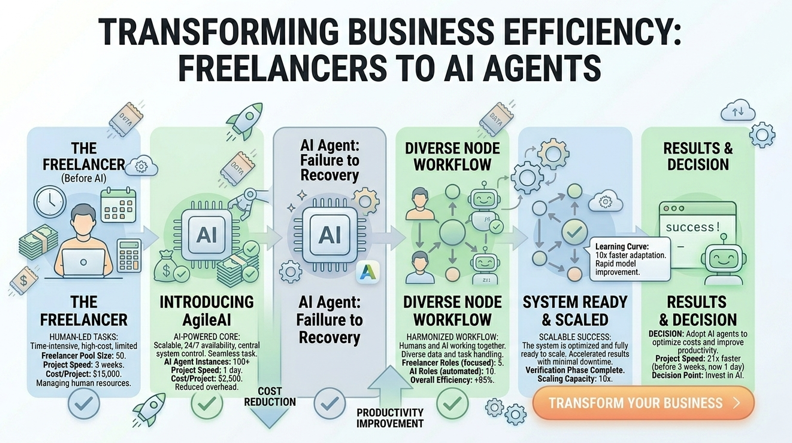
Before: $4,720 per month, 3 contractors, roughly 160 hours of human labor per week handled.
After: $312 per month average across the 90 days, 3 agents, the equivalent of about 140 hours of work handled. The 20-hour gap is the qualitative stuff the agents simply don’t catch.
Net monthly savings: $4,408. Annualized: $52,896. Setup time investment: roughly 60 hours over the first month, which works out to a payback period of less than two weeks once everything stabilized.
The platform fees were predictable. Most managed agent services charge per agent, and the pricing is straightforward enough that you can model your costs ahead of time. I checked BetterClaw pricing early on and used their per-agent number as a baseline because it made the math easy. Three agents at a flat monthly rate plus model costs is simple to forecast, which mattered when I was justifying the experiment to myself.
See also: How Technology Innovation Shapes Modern Business Strategy
What I’d do differently
Three things, in order of how much they cost me.
First, I would not have tried to self-host. The eleven hours I spent fighting Docker were worth more than the $19 a month I would have saved. If you are not already running production infrastructure for a living, the time math on a managed OpenClaw alternative is impossible to argue with. Your hours are the expensive part of the equation.
Second, I would have kept one freelancer. My VA, specifically. Not for the email work, which the agent now does better, but for the meta-work of noticing patterns and surfacing things I should care about. A part-time human strategist plus a fleet of agents is probably the right configuration for most solo founders, not pure agent replacement.
Third, I would have written better escalation rules earlier. My biggest agent failures in the first month were all cases where the agent should have stopped and asked, but didn’t. Being more conservative with autonomy thresholds at the start would have saved me three angry customer emails and one mildly horrified accountant.
The honest verdict
The agents are real. The savings are real. The productivity gains are real, and they compound over time as you get better at scoping tasks for them.
But the dream of fully replacing humans with software is still a dream, and probably should be. The right question isn’t whether to replace your freelancers with agents. It’s which 80 percent of their work is repetitive enough to automate, and which 20 percent is exactly the thing that made them worth hiring in the first place.
That second 20 percent is where the future actually gets interesting. Because once the routine work is gone, the humans who remain in your business get to spend all their time on the parts of the job that only humans can do. That’s not a loss for them. For the right people, it’s the best version of the job they’ve ever had.