Modern Approaches in Interventional Chronic Pain Management
The landscape of chronic pain management has been revolutionized by advancements in interventional techniques, offering targeted relief for conditions like facet joint pain. These small, cartilage-lined joints connect the vertebrae along the back of your spine, from the cervical (neck) to the lumbar (lower back) regions. When these joints become inflamed or arthritic, they can be a significant source of discomfort, leading to axial pain that can radiate to the buttocks, upper legs, shoulders, or head, depending on the affected area.
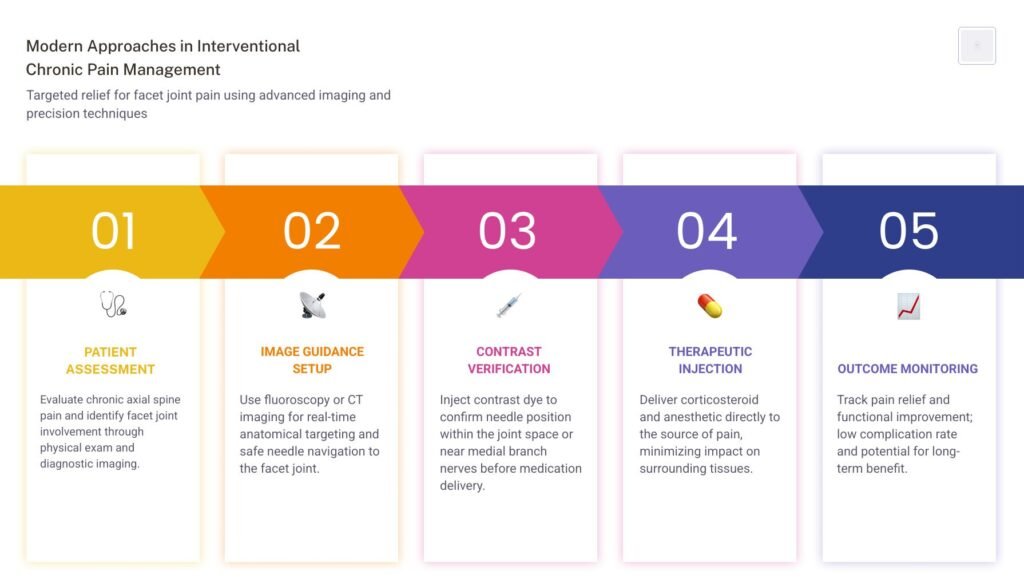
Modern interventional procedures, such as facet joint injections, are designed to precisely address this pain. They rely heavily on sophisticated imaging guidance, like fluoroscopy (a type of real-time X-ray) or CT imaging, to ensure the accurate placement of medication. This anatomical targeting is crucial, as it allows clinicians to deliver therapeutic agents directly to the source of pain, minimizing impact on surrounding tissues. Before injecting the medication, a contrast dye is often used to verify needle position within the joint space or around the nerves supplying it. This meticulous approach not only enhances the effectiveness of the treatment but also significantly reduces the risk of complications. For a deeper dive into the benefits and considerations of these procedures, particularly regarding whether they are “ouch” or “oh so worth it,” exploring resources on chronic pain management can provide valuable insights.
Precision Image Guidance in Interventional Chronic Pain Management
The cornerstone of safe and effective facet joint injections is precision image guidance. During the procedure, clinicians utilize live fluoroscopy, providing a dynamic, real-time view of the spine. This allows for continuous monitoring of the needle’s path as it approaches the facet joint. The injection of a small amount of contrast dye serves as a critical step, outlining the joint capsule or nerve pathway to confirm the exact needle position before any therapeutic medication is delivered. This ensures the medication reaches its intended target, whether directly into the joint (intra-articular) or around the medial branch nerves that innervate the joint.
This meticulous needle precision is paramount. Facet joints are delicate structures, and accurate placement helps maintain the integrity of the joint capsule while also avoiding damage to adjacent structures. The use of image guidance dramatically lowers the complication rate, making these procedures remarkably safe. Serious nerve injury, for instance, is extremely rare, occurring in less than 1 in 10,000 cases. This commitment to precision underscores our dedication to patient safety and optimal outcomes.

Facet Joint Injections and Targeted Neuromodulation
Facet joint injections serve both diagnostic and therapeutic purposes. As a diagnostic tool, they help pinpoint whether the facet joints are indeed the source of a patient’s pain. This is typically achieved by injecting only a local anesthetic into or around the joint. If the patient experiences significant, albeit temporary, pain relief (often defined as 70-80% reduction for the duration of the anesthetic), it strongly suggests the facet joint as the pain generator. This diagnostic accuracy is high, identifying the pain source in approximately 85% to 90% of cases.
Therapeutically, these injections often combine a local anesthetic with a corticosteroid. The local anesthetic provides immediate, short-term pain relief, while the corticosteroid works to reduce inflammation within the joint, offering longer-lasting relief. These intra-articular injections target the joint directly. Alternatively, a medial branch block might be performed, where the anesthetic and steroid are injected around the medial branch nerves that transmit pain signals from the facet joints. This approach is particularly useful for identifying the specific nerves responsible for the pain, often as a precursor to radiofrequency ablation.
Facet joint pain can manifest in various spinal regions. In the cervical spine (neck), facet issues can cause headaches, neck pain, and pain radiating to the shoulders or upper back. In the lumbar vertebrae (lower back), facet pain often presents as low back pain that can spread to the buttocks or upper thighs. By precisely delivering corticosteroid medication to these specific areas, we aim to interrupt the pain cycle and provide substantial relief.
Understanding Procedural Comfort and Pain Mitigation
A natural concern for anyone considering an injection, especially in the spine, is the potential for pain. We understand this apprehension and prioritize patient comfort throughout the facet joint injection procedure. Our approach focuses on minimizing discomfort through careful preparation and effective pain management strategies.
Before the actual injection of medication into the facet joint, the skin and underlying tissues at the injection site are thoroughly numbed with a local anesthetic. Patients typically describe this initial step as a brief, mild sting or pinch, similar to what one might feel during a routine blood draw or dental procedure. Once the numbing agent takes effect, the area becomes desensitized, significantly reducing any sharp pain sensations.
During the main injection, patients generally report feeling a sensation of pressure, tightness, or pushing rather than sharp pain. This pressure is due to the needle advancing and the medication being administered into the joint space or around the nerves. While some individuals might experience a mild, dull ache, it is usually well-tolerated. Our team continuously monitors patient comfort and encourages open communication, allowing us to adjust as needed to ensure the experience is as comfortable as possible. This meticulous pre-procedure prep is a key component of our patient-centered care.
Intra-Procedural Sensation and Anesthetic Protocols
During the facet joint injection, our team employs several protocols to manage sensations and ensure patient comfort. After the initial skin numbing with a local anesthetic like lidocaine, the primary sensation felt is typically pressure. This pressure arises as the needle is carefully guided into position using fluoroscopy and as the medication, a mix of anesthetic and often a corticosteroid, is gently injected. Patients are encouraged to communicate any discomfort they experience, allowing the medical team to respond immediately.
While the goal is to minimize pain, some individuals may feel a transient, deep pressure discomfort or a dull ache. This is a normal part of the process and is usually temporary. In some cases, if a patient is particularly anxious or has a low pain threshold, mild procedural sedation might be offered. However, for diagnostic injections, sedation is often avoided to ensure the patient can accurately report their pain response, which is crucial for identifying the pain source. Throughout the procedure, vital signs are continuously monitored, and the healthcare team maintains constant verbal contact to provide reassurance and address any concerns. This continuous sensory feedback and team monitoring ensure a safe and comfortable experience.

Post-Procedure Soreness Management and Recovery Timelines
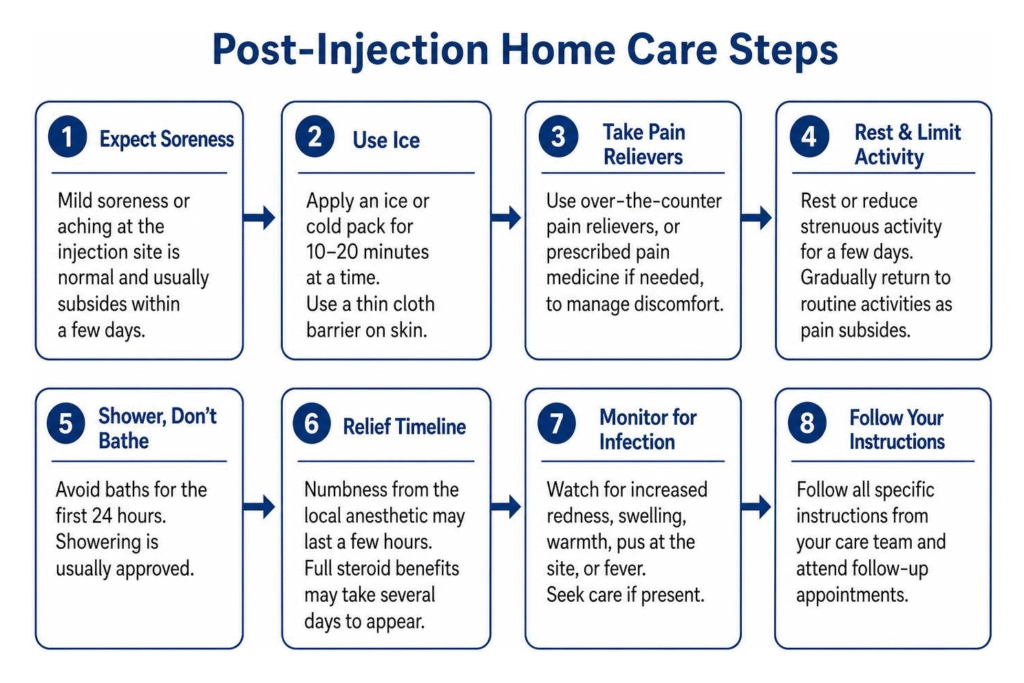
Immediately following a facet joint injection, it’s common to experience some soreness or aching at the injection site. This is often described as a “steroid flare” if a corticosteroid was used, and it typically subsides within a few days. The local anesthetic effects might cause temporary numbness in the treated area, which can last for a few hours. While some patients report immediate pain relief from the anesthetic, the full therapeutic effects of the corticosteroid may take several days to become apparent.
To manage any post-procedure discomfort, applying an ice or cold pack to the injection site for 10-20 minutes at a time can be very effective. A thin cloth barrier should always be used between the ice pack and the skin. Over-the-counter pain relievers, or prescribed pain medicine if necessary, can also help. We recommend resting or reducing strenuous activity for a few days, but gradually returning to routine activities is encouraged as pain subsides. This helps to assess the true effectiveness of the injection. Patients should also avoid baths for the first 24 hours but showering is usually approved.
Infections are extremely rare, occurring in only 1% to 2% of all facet joint injections. However, it’s crucial to monitor for any signs of infection, such as increased redness, swelling, warmth, or pus at the injection site, or fever.
Here are some general post-injection home care steps:
Diagnostic Accuracy Versus Therapeutic Longevity in Spinal Injections
Facet joint injections play a dual role in spinal pain management: they are both powerful diagnostic tools and effective therapeutic interventions. The diagnostic utility of these injections is exceptionally high. By temporarily blocking pain signals from specific facet joints using a local anesthetic, clinicians can accurately identify if these joints are indeed the source of a patient’s pain. This “pain mapping” is crucial, especially since facet joint pain can mimic other spinal conditions. If a patient experiences at least 50% pain reduction after a diagnostic injection, it strongly suggests the facet joint as the pain generator, with an accuracy rate of approximately 85% to 90%.
Once the pain source is confirmed, the therapeutic outcomes of facet joint injections can be significant. When a corticosteroid is included with the anesthetic, it aims to reduce inflammation within the joint, leading to longer-lasting pain relief. While the immediate relief from the anesthetic is temporary, the steroid’s effects can last for several weeks to months. However, it’s important to manage expectations regarding long-term relief. For some, the relief may be short-lived, while others experience a significant reduction in pain for 3-6 months or even longer. This variability underscores the need for a personalized approach to treatment and follow-up.
Assessing Efficacy in Interventional Chronic Pain Management
Evaluating the success of facet joint injections involves a careful assessment of pain reduction and functional improvement. We encourage patients to keep a pain diary after the procedure, noting their pain levels and how they respond to daily activities. This helps us understand the true efficacy of the injection. A therapeutic success rate for facet joint injections typically ranges from 50% to 80% of patients experiencing meaningful pain relief.
The “50% threshold” is often used to define a clinically significant improvement, meaning the patient’s pain has reduced by at least half. For diagnostic purposes, an even higher threshold, such as 70-80% relief for 48 hours, might be used to definitively confirm the facet joint as the pain source. The therapeutic window, or how long the pain relief lasts, varies among individuals. While some may find relief for 3-6 months, others might experience shorter durations. If the relief is substantial but short-lived, repeat protocols can be considered, often up to 3 times per year. If injections provide only temporary relief, other options like radiofrequency ablation might be explored for more sustained results.

Comparing Joint Blocks, Epidurals, and Radiofrequency Ablation
When discussing interventional spinal procedures, it’s helpful to understand the distinctions between various treatments, as they target different anatomical structures and pain mechanisms.
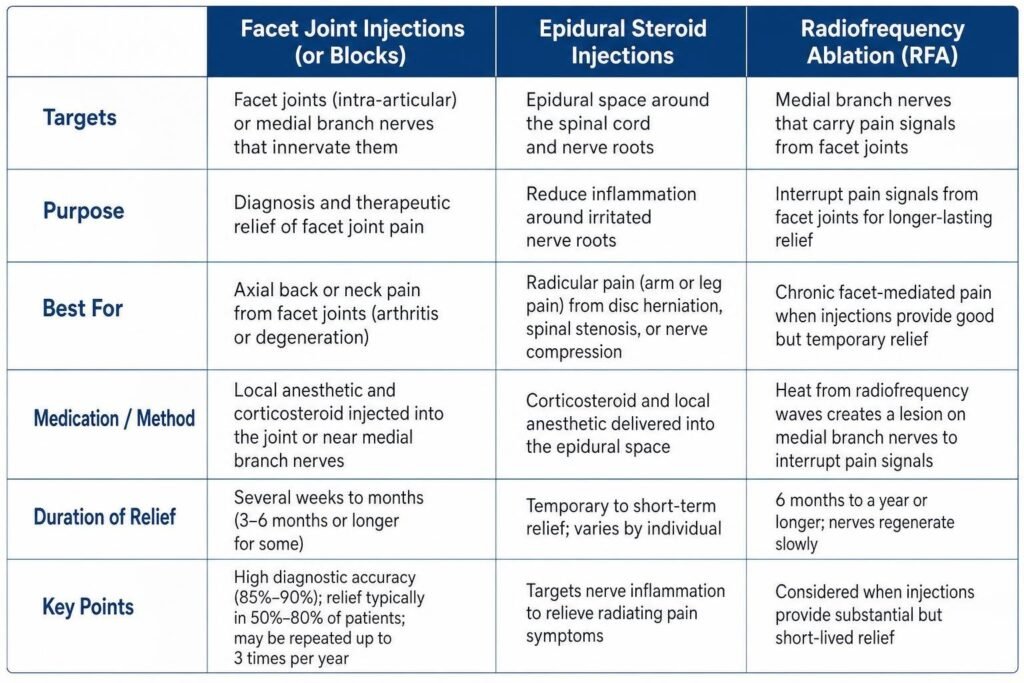
- Facet Joint Injections (or Blocks): As discussed, these target the facet joints themselves (intra-articular) or the medial branch nerves that innervate them. They are primarily used for axial back or neck pain originating from these joints, often due to arthritis or degeneration. The goal is to diagnose the pain source and provide therapeutic relief through local anesthetic and corticosteroid delivery. Facet joints have dual innervation from the same level and one above, making medial branch blocks effective for targeting these specific nerves.
- Epidural Steroid Injections: These injections deliver medication into the epidural space, which surrounds the spinal cord and nerve roots. Epidurals are typically used to treat radicular pain (pain that radiates down an arm or leg), often caused by disc herniations, spinal stenosis, or nerve compression. The medication, usually a corticosteroid and local anesthetic, reduces inflammation around the irritated nerve roots.
- Radiofrequency Ablation (RFA): This is a longer-lasting procedure, often considered if facet joint injections provide good but temporary relief. RFA uses heat generated by radiofrequency waves to create a lesion on the medial branch nerves, effectively interrupting the pain signals from the facet joints to the brain. This “nerve ablation” can provide pain relief for 6 months to a year or even longer, as the nerves regenerate slowly. It’s a targeted approach to pathway interruption for chronic facet-mediated pain.
Each of these procedures has specific indications and benefits, and the choice depends on the patient’s diagnosis, pain characteristics, and response to previous treatments.
Frequently Asked Questions About Interventional Spine Procedures
Patients often have many questions when considering interventional spine procedures. Here, we address some of the most common concerns, particularly around the experience of pain and expected outcomes.
Are facet joint injections painful during the procedure?
The primary concern for many patients is the pain experienced during the facet joint injection itself. We can reassure you that significant pain during the procedure is typically not expected. Before the main injection, the skin and underlying tissues are thoroughly numbed with a local anesthetic. This initial numbing causes a brief, mild stinging sensation, similar to a quick pinch. Once the area is numb, you should primarily feel pressure, tightness, or a pushing sensation as the needle is guided into place and the medication is injected.
Our team continuously monitors your comfort level throughout the procedure. While individual pain tolerance varies, most patients describe the experience as minimal discomfort, often comparing it to the feeling of a deep massage rather than sharp pain. If you feel any discomfort, it’s important to communicate this to the medical team so they can make adjustments or offer additional reassurance.
How long does relief typically last after an injection?
The duration of pain relief following a facet joint injection can vary. Immediately after the procedure, the local anesthetic provides an anesthetic duration of relief that can last for several hours. This immediate relief is often used diagnostically to confirm the facet joint as the pain source.
If a corticosteroid is included in the injection, its anti-inflammatory effects typically begin to take hold after a few days. The therapeutic relief from the steroid can last anywhere from 3 to 6 months, and sometimes longer. The steroid onset is not immediate, and it’s common to experience some soreness or a temporary increase in pain for a few days before the steroid begins to work.
For patients who experience significant but short-lived relief, the injection may be repeated, usually up to three times per year. If the relief consistently falls short of expectations, or if the diagnostic window indicates the facet joints are indeed the pain source but relief is not sustained, your doctor may discuss other options, such as a radiofrequency transition to a more long-term solution like radiofrequency ablation.
What are the main signs of complications following spinal injections?
While facet joint injections are generally considered safe procedures with a low risk of complications, it’s important for patients to be aware of potential issues and when to seek medical attention. Serious complications are rare, with serious nerve injury occurring in less than 1 in 10,000 cases, and infections in only 1% to 2% of all facet joint injections.
However, you should seek medical evaluation if you experience any of the following symptoms:
- Signs of infection: Increased redness, swelling, warmth, or pus at the injection site; fever (temperature over 100.4°F or 38°C); or chills.
- Worsening weakness or numbness: New or significantly worsening weakness or numbness in an arm or leg, or loss of bladder or bowel control.
- Severe or persistent pain: Pain that is significantly worse than expected, does not improve with medication, or is accompanied by other concerning symptoms.
- Allergic reaction: Rash, itching, swelling, severe dizziness, or trouble breathing.
- Other unexpected symptoms: Chest pain, breathlessness, or any other symptoms that cause you concern.
If you experience any of these signs, especially fever symptoms or worsening weakness, contact your doctor immediately or seek emergency medical care. Our priority is your safety and well-being, and prompt medical attention can prevent minor issues from becoming more serious.
See also:
Conclusion
Facet joint injections represent a crucial component of modern interventional chronic pain management, offering both precise diagnostic capabilities and effective therapeutic relief. By leveraging advanced imaging techniques and a meticulous approach, we prioritize patient comfort and safety, debunking the myth that these procedures are inherently painful. With local anesthesia and careful technique, the experience is typically one of minimal discomfort, primarily pressure.
We are committed to evidence-based care, ensuring that each treatment plan is tailored to the individual’s needs, aiming for sustained pain relief and improved quality of life. Our goal is to restore mobility, reduce discomfort, and enhance overall spinal health, empowering patients to return to their daily activities with greater ease. If you are experiencing chronic spinal pain, discussing facet joint injections with a pain specialist can be an important step towards finding lasting relief.